Best Sourdough Starter Kits & Banneton Baskets (2026)
Updated 202614 min read6 products reviewed
Affiliate Disclosure: We may earn a commission if you purchase through our links, at no extra cost to you. Our editorial selections are independent.
Sourdough bread is fermentation at its most tactile and rewarding. Unlike most kitchen projects, sourdough is a living practice — a daily or weekly ritual of feeding, observing, and adjusting that builds an intuitive relationship between baker and culture. The starter is the foundation: a thriving colony of wild yeast and lactic acid bacteria that, when healthy, reliably leavens bread with complex flavor that commercial yeast cannot approach. In 2026, the sourdough supply market has matured into a rich ecosystem of starter cultures, proofing tools, and scoring instruments. We evaluated six essential items across the starter-to-table workflow for quality, longevity, and practical value for home bakers.
Quick Comparison
Product
Best For
Key Feature
Top Con
Link
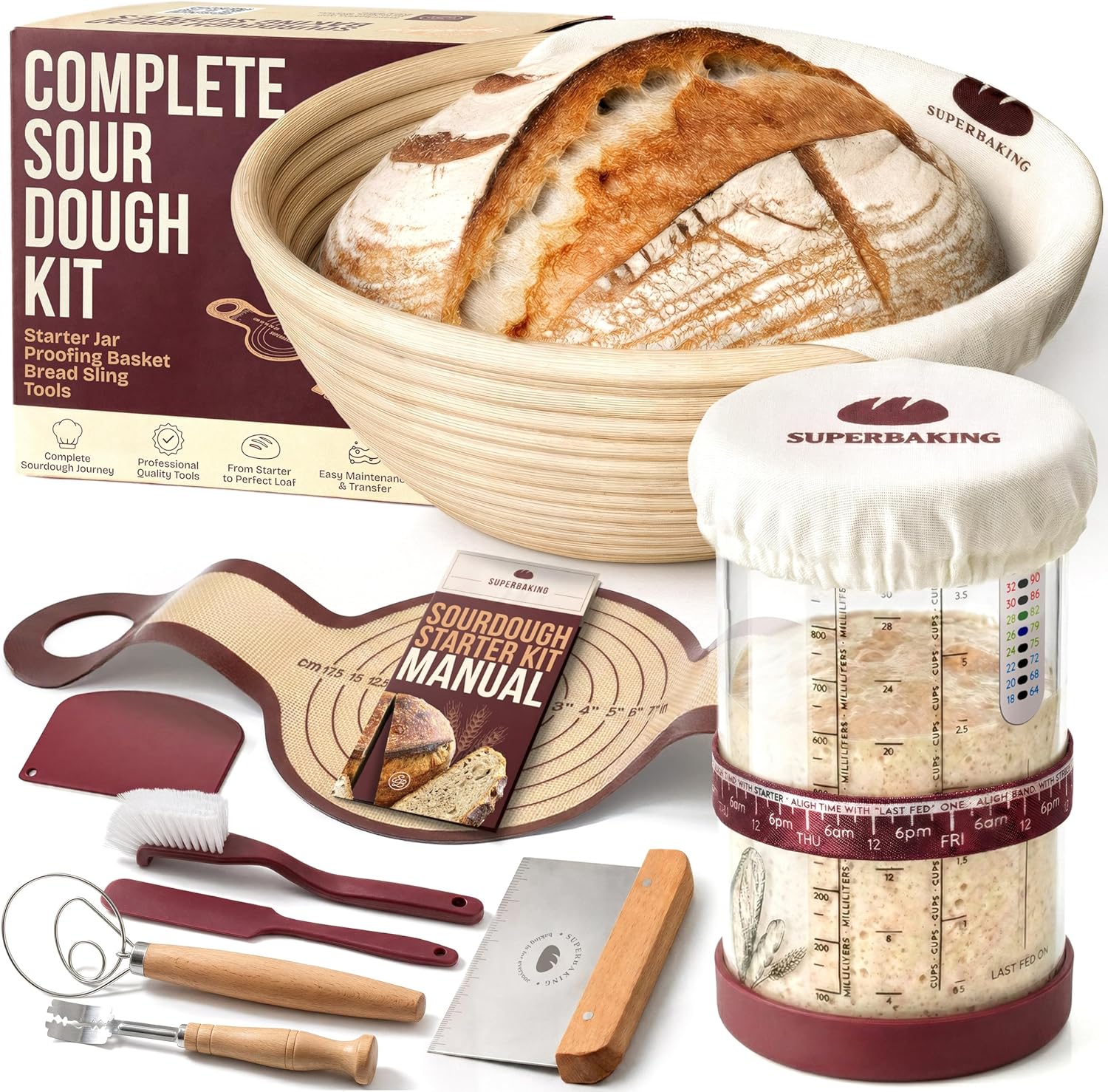
Superbaking Sourdough Starter Kit with Banneton & Glass Jar
Best Overall
Complete kit eliminates the need to source starter jar, banneton, and tools separately
Starter culture not included — must be sourced separately or built from scratch
Pro Tip: Use rice flour (not all-purpose) for dusting bannetons — it won't absorb into the dough surface and guarantees clean release every time.
1.EDITOR'S PICK
Superbaking Sourdough Starter Kit with Banneton & Glass Jar
A comprehensive sourdough starter kit from Superbaking that includes a banneton proofing basket, glass starter jar, and essential tools — everything for the first-time sourdough baker in one organized package.
Considerations
Starter culture not included — must be sourced separately or built from scratch
Banneton size may be limiting for bakers targeting loaves above 1kg
Complete kit eliminates the need to source starter jar, banneton, and tools separately
Splinter-free rattan banneton creates the classic spiral pattern on finished loaves
Glass jar with measurement markings helps track starter rise levels precisely
Thoughtful packaging presents as a gift-worthy introduction to sourdough baking
Beginning sourdough bakers who want every essential tool in one organized kit without hunting for individual components across multiple purchases.
Set up your starter culture in the glass jar, feeding daily until reliably active. After bulk fermentation, shape your dough and proof in the rice-flour-dusted banneton. Score and bake in a Dutch oven or bread cloche.
San Francisco 100+ Year Old Sourdough Starter Culture
A dehydrated San Francisco sourdough starter culture with over 100 years of documented lineage — a heritage culture that produces the characteristic mild tang and open crumb of traditional San Francisco sourdough.
Considerations
5–7 day activation period required before first bake — not immediately usable
San Francisco flavor profile is specific — not a neutral or highly customizable culture
Authentic 100+ year old strain with a documented, consistent flavor profile
Dehydrated format ships year-round without temperature sensitivity or live culture risk
Detailed activation instructions guide beginners through the 5–7 day activation process
Established strain activates reliably compared to wild-capture starters that can fail
Sourdough beginners who want a proven, heritage culture with well-documented flavor characteristics and reliable activation, eliminating the uncertainty of building from scratch.
Combine the dehydrated starter packet with equal weights of unbleached bread flour and lukewarm filtered water. Feed twice daily for 5–7 days at room temperature until the starter reliably doubles within 4–6 hours of feeding.
Sourdough Starter Kit with Banneton, Scraper, Whisk, Lame
A full sourdough workflow kit including banneton basket, dough scraper, Danish dough whisk, and lame scoring tool — the four accessories that cover every step from mixing to scoring.
Considerations
No starter culture or jar included — add separately for a complete setup
Lame blade will eventually need replacement; check blade availability before purchasing
Four essential tools cover the entire sourdough process in one purchase
Dough scraper handles bench work, dough division, and bowl cleaning
Lame scoring tool creates the expansion scores needed for proper oven spring
Home bakers who already have or are acquiring a starter culture and need the workflow tools — whisk, scraper, banneton, and lame — without buying each component individually.
Use the dough whisk for autolyse and mixing, the scraper for bench work and shaping, the banneton for final proofing, and the lame to score just before loading the preheated Dutch oven.
Superbaking 2-Pack Banneton Proofing Baskets with Liners
Two Superbaking banneton proofing baskets with linen liners included — a beginner-friendly pair that lets you proof two loaves simultaneously and experiment with lined versus unlined proofing.
Considerations
Liners need thorough drying between uses to prevent mold in humid environments
Round basket shape only — batard bakers will need an oval basket separately
Two-pack enables back-to-back proofing batches or side-by-side hydration experiments
Linen liners prevent sticking when using higher-hydration doughs that can adhere to rattan
Splinter-free rattan construction is safe for hands during dusting and dough handling
Uniform coil pattern imprints the classic sourdough spiral on the finished loaf surface
Beginning sourdough bakers who want to proof two loaves at once and experiment with linen-lined versus bare rattan proofing to understand how each affects crust texture.
Dust generously with rice flour (not all-purpose), shape the dough, and place seam-side up in the basket. Cover and cold-proof in the refrigerator 8–16 hours. Score and bake directly from cold.
Sourdough Proofing Basket Gift Set Round + Oval with Lame & Whisk
A premium gift set including both a round and an oval banneton basket, a metal lame, and a Danish dough whisk — covering boule and batard loaf shapes plus the scoring and mixing tools.
Considerations
Larger investment than single-basket alternatives — best for committed bakers
Two bannetons require storage space and consistent rice flour maintenance
Both round and oval bannetons cover the two most common sourdough loaf shapes
Metal lame creates the deep, controlled scores needed for dramatic oven spring
Danish dough whisk handles high-hydration mixing without overworking gluten
Complete set presents beautifully as a gift for any home baker
Dedicated sourdough bakers who want to master both boule and batard shapes and need the tools — whisk, lame, and both basket shapes — to do it without compromise.
Choose the round basket for boule loaves, the oval for batard shapes. Dust generously with rice flour, proof the shaped dough seam-side up, and score with the lame just before loading into the preheated baking vessel.
Dimpola Banneton Bread Proofing Basket Set of 2 Handmade Rattan
A set of two handmade rattan banneton baskets — a premium artisan option for bakers who value natural materials and the authentic spiral pattern that only real rattan coils can produce.
Considerations
Handmade construction means slight variation between individual baskets in the set
Rattan requires careful drying between uses to prevent mold in high-humidity environments
Handmade rattan provides the authentic spiral patterning associated with artisan sourdough
Natural material breathes correctly to manage moisture during the long cold proof
Two-basket set allows double-batch proofing or back-to-back baking sessions
Durable rattan construction lasts for years with minimal flour-dusting maintenance
Experienced sourdough bakers who appreciate natural handmade tools and want the authentic rattan banneton aesthetic paired with the practical benefit of a two-basket set.
Season with rice flour for 24 hours before first use. After bulk fermentation, shape your dough, dust the basket, place dough seam-side up, and cold-proof. Turn out directly onto a peel or Dutch oven before baking.
Note: The 'poke test' for proofing: poke the shaped dough with a floured finger. If it springs back quickly, it needs more time. If it springs back slowly and incompletely, it's ready to score and bake.
Buying Guide
Choosing a Sourdough Starter Culture
Your starter culture is the most important sourdough decision you will make. Dehydrated starters from reputable companies offer verified activity, regional flavor character, and long shelf life before activation. These are ideal for beginners because they come with detailed activation guidance and produce reliable results. Live starters from friends or local fermentation communities can be immediately active but arrive with unknown histories. Building your own starter from scratch — flour, water, and wild ambient yeast — takes 7–14 days and produces a culture uniquely adapted to your local environment. All three approaches work; dehydrated commercial starters offer the most reliable first experience. Research from the American Society for Microbiology has documented over 50 distinct microbial species in sourdough starters, with composition varying significantly by geography and flour type.
The Role of the Banneton in Proofing
A banneton (also called a brotform or proofing basket) serves two functions: it supports the shaped dough's structure during its final rise, and it creates the characteristic spiral flour pattern on the finished loaf's surface. Rattan bannetons are the traditional choice — the coiled cane structure absorbs and redistributes moisture evenly, preventing surface condensation that would cause sticking. The tight spiral pattern transfers to the dough, creating the aesthetic most associated with artisan sourdough. Bannetons should always be dusted generously with rice flour rather than all-purpose flour — rice flour's lack of gluten prevents it from absorbing into the dough and causing sticking. Linen liners are an alternative to bare rattan for higher-hydration doughs that tend to stick.
Scoring Tools: Lame vs. Razor vs. Kitchen Knife
Scoring — cutting the surface of the shaped dough just before loading into the oven — allows controlled expansion during the oven spring. Without scoring, bread expands unpredictably and may tear at weak points rather than opening along intentional score lines. A lame (pronounced 'lahm') is a specialized scoring tool: a handle holding a curved or straight razor blade at a specific angle. The curve of a typical lame blade creates the dramatic ear (the raised ridge) that defines great sourdough. Straight razor blades held at a 30–45 degree angle produce clean, deep scores. A sharp kitchen knife or serrated blade can work in a pinch but produces less clean cuts than a dedicated lame. King Arthur Baking's sourdough resources recommend replacing lame blades after every 10–12 scoring sessions to maintain cut quality.
Proofing Basket Sizing and Materials
Banneton size is matched to dough weight and the style of loaf being produced. A 9-inch round banneton suits doughs between 750g and 1kg — the standard range for a single sourdough boule. A 10-inch round accommodates doughs up to 1.2kg. Oval bannetons produce the traditional batard (oblong) shape, typically accommodating the same weight range as the corresponding round size. Rattan is the most common material: natural, breathable, and produces the cleanest spiral pattern. Cane wicker is similar. Plastic or silicone proofing baskets are available but lack the moisture management properties that rattan provides. Natural rattan requires seasoning with rice flour before first use to fill the spaces between coils that would otherwise create sticking on initial batches.
A ready starter reliably doubles in size within 4–6 hours of feeding, shows vigorous bubble activity throughout (not just on the surface), has a pleasantly yeasty-sour smell, and passes the float test: a small spoonful dropped in water floats. If your starter only doubles slowly (8+ hours), has few bubbles, or smells off, continue feeding twice daily at consistent times until activity improves.
Inconsistent feeding is the most common cause of slow starter development. Feed at the same time each day using the same flour-to-water ratio. Water temperature matters: 70–78°F is ideal — too cold slows yeast activity significantly. Chlorinated tap water can inhibit microbial development; switch to filtered water if you suspect this. Some flours (especially heavily bleached white flour) ferment slowly — try adding 20% whole wheat or rye flour to boost wild yeast capture.
A fed starter can stay at room temperature and be used daily. For less frequent baking, refrigerate after feeding and bring back to room temperature 24–48 hours before baking, giving it a fresh feeding first. A refrigerated starter can go 1–2 weeks between feedings with minimal deterioration. For long-term storage, dehydrate a portion by spreading thinly on parchment paper, allowing to fully dry, then crushing and storing in an airtight container — this preserves your culture indefinitely.
All-purpose unbleached wheat flour is the standard choice for its consistent protein content and availability. Whole wheat flour accelerates fermentation and produces more complex flavor due to higher mineral and fiber content. Rye flour is particularly active — small additions (10–20% of feeding flour) can dramatically boost a sluggish starter. Bread flour works well but is not necessary for starter maintenance. Avoid bleached flour and self-rising flour, which contain additives that inhibit microbial activity.
Sourness in sourdough comes from acetic acid (sharp, vinegar-like) and lactic acid (mild, yogurt-like). To reduce sourness: use starter at peak activity just after doubling, use more starter in your dough recipe, proof at cooler temperatures which favor lactic over acetic acid production, and reduce bulk fermentation time. Baking at higher temperatures also reduces perceived sourness. San Francisco sourdough strains naturally produce more acetic character than European strains.
After each use, allow the banneton to dry completely before storing — moisture retained in rattan can lead to mold. Brush out excess flour with a dry brush (never wash with water and soap, which damages the rattan and promotes mold growth). Store in a dry location with airflow. A light dusting of rice flour before each use maintains the non-stick properties. With proper drying and storage, a quality rattan banneton lasts many years of weekly use.
Our Recommendation
For most home cooks, our Best Overall pick — Superbaking Sourdough Starter Kit with Banneton & Glass Jar — offers the best balance of performance, reliability, and value. If budget is a priority, our Best Value pick — San Francisco 100+ Year Old Sourdough Starter Culture — delivers excellent results at a lower investment. Experienced cooks who want maximum performance should consider our Editor's Pick — Sourdough Starter Kit with Banneton, Scraper, Whisk, Lame.